 Data & metrics
Ramp Test Results Explained — Where Your FTP Number Comes From
Finished your ramp test — now what? Where the 75% factor comes from, when the result over- or underestimates your FTP, and how to use it in training.
 Data & metrics
Alpe du Zwift — How to Pace an Hour-Long Climb Without Blowing Up Halfway
Alpe du Zwift is roughly 12.2 km and 1000 m of climbing. For most riders it's an hour near threshold, and the most common mistake is starting too hard.
 Data & metrics
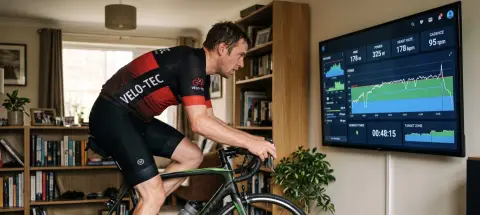
Four Months on a Smart Trainer — What It Really Does for Fitness When You Return to the Road
A season of structured indoor training raises FTP and VO2max comparably to outdoor riding, provided volume and intensity stay consistent.
 Data & metrics
Spring Fatigue and Training — Why Power Drops in Spring Despite a Good Plan
Spring fatigue is a real physiological effect from circadian shift, low vitamin D, and pressure swings. It's easy to mistake for overtraining, but they need different responses.
 Data & metrics
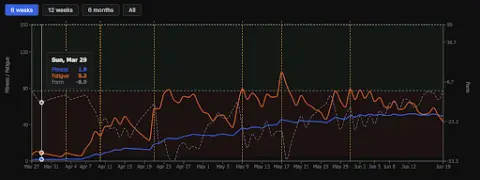
PMC chart — how to read it and manage your form
How to read the Performance Management Chart: Fitness (CTL), Fatigue (ATL), Form (TSB) explained with practical examples for training planning and tapering.
 Data & metrics
How to Prepare for a Ramp Test — the 24 Hours Before Your FTP Test
Fresh legs, cooling, cadence, caffeine and headspace. A complete ramp test preparation plan so your result shows real fitness, not fatigue.
 Data & metrics
How to Analyze a Ride File? 5 Things You Must Look At
FIT file analysis in 5 steps: interval execution, NP and IF, time in zones, heart rate vs power divergence and new power records.
 Data & metrics
Power zones in cycling — Coggan's 7 zones in practice
You've measured your FTP — now what? What each zone trains, how to calculate zones from FTP, and how to build workouts with them.
 Data & metrics
How to measure FTP — Ramp Test step by step
A complete guide to measuring FTP using the Ramp Test: preparation, protocol, calculation and what to do with your result.
 Data & metrics
Left/Right Leg Power Balance — Does It Actually Affect Your Results?
L/R power balance from pedals: what's normal, when 45/55 is a problem, and when it's just measurement noise. Data over myths.
 Data & metrics
VLaMax — Why a Great Sprint Can Wreck Your Endurance
A high capacity for anaerobic power output (VLaMax) costs something on the other end: fat burning and long-distance endurance. How this tradeoff actually works.
 Data & metrics
How a Heart Rate Monitor Works and Which One to Choose for Cycling
A heart rate monitor is the cheapest way to objectively measure training intensity. Before spending on a power meter, a chest strap gives you more than speed alone.