Cycling Dynamics from Power Pedals — How to Read the Data
Cycling Dynamics shows how you actually pedal — how much power comes from your left versus right leg, where in the crank rotation you produce that power, and how your foot position on the pedal (Platform Center Offset) plays into it. Using one ride on Favero Assioma Pro MX power pedals, recorded with a Garmin Edge 840 and read out in the Garmin Connect app, here's what these numbers mean.
What is Cycling Dynamics?
It's a set of metrics about pedaling technique, not raw power. The key ones: Left/Right Balance, Power Phase (the crank-angle range where you actually transmit force), and Platform Center Offset (PCO) — where force is applied on the pedal platform, tracked separately for each leg.
L/R balance and Power Phase in practice
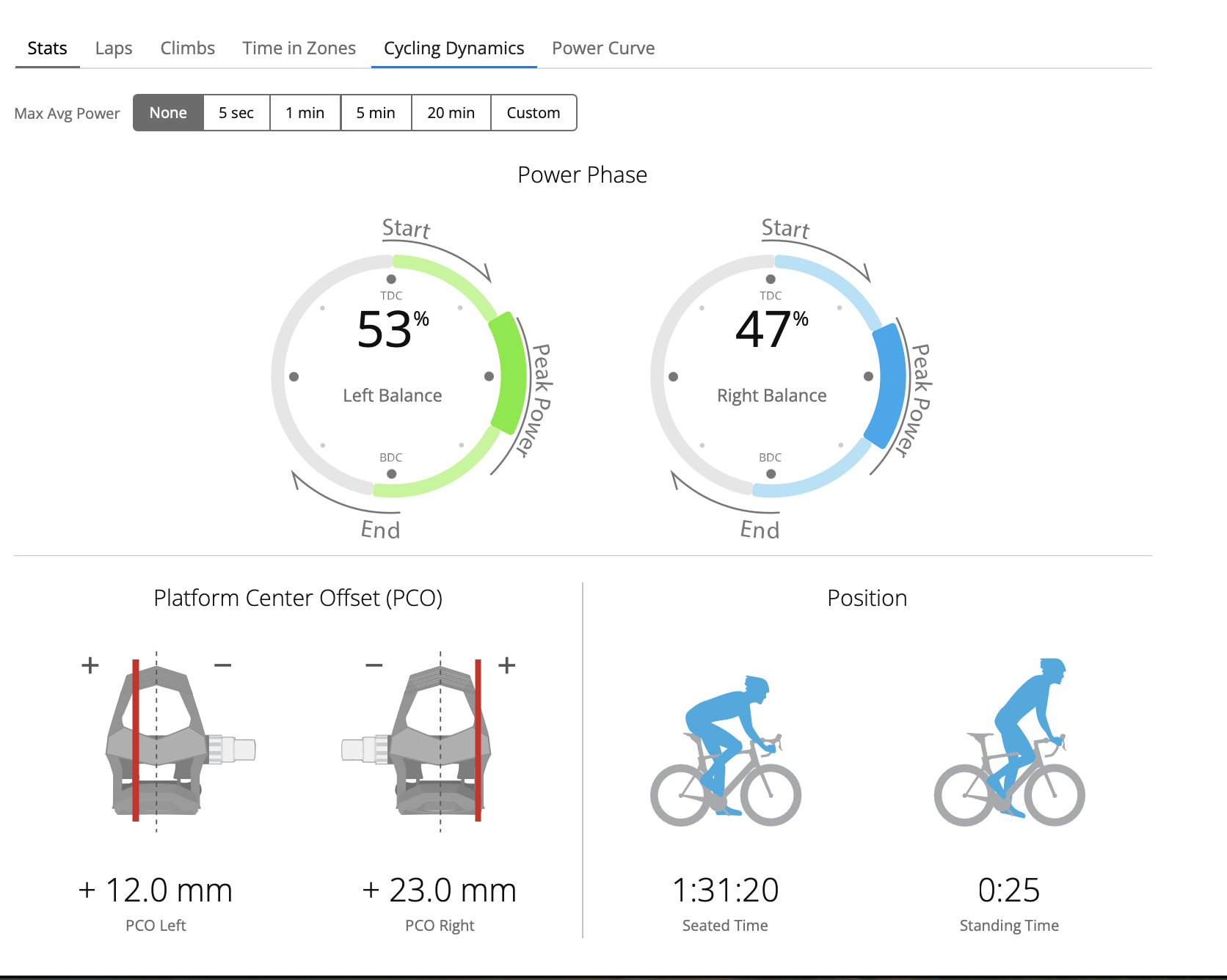
On this ride, balance came out to 53% left / 47% right — a small asymmetry, common even among experienced riders. Power Phase shows peak power starting shortly after 12 o'clock (TDC) and ending before 6 o'clock (BDC) on both legs, meaning most force is generated in the upper half of the stroke — typical for riders without dedicated technique training.
How does it change over the ride?
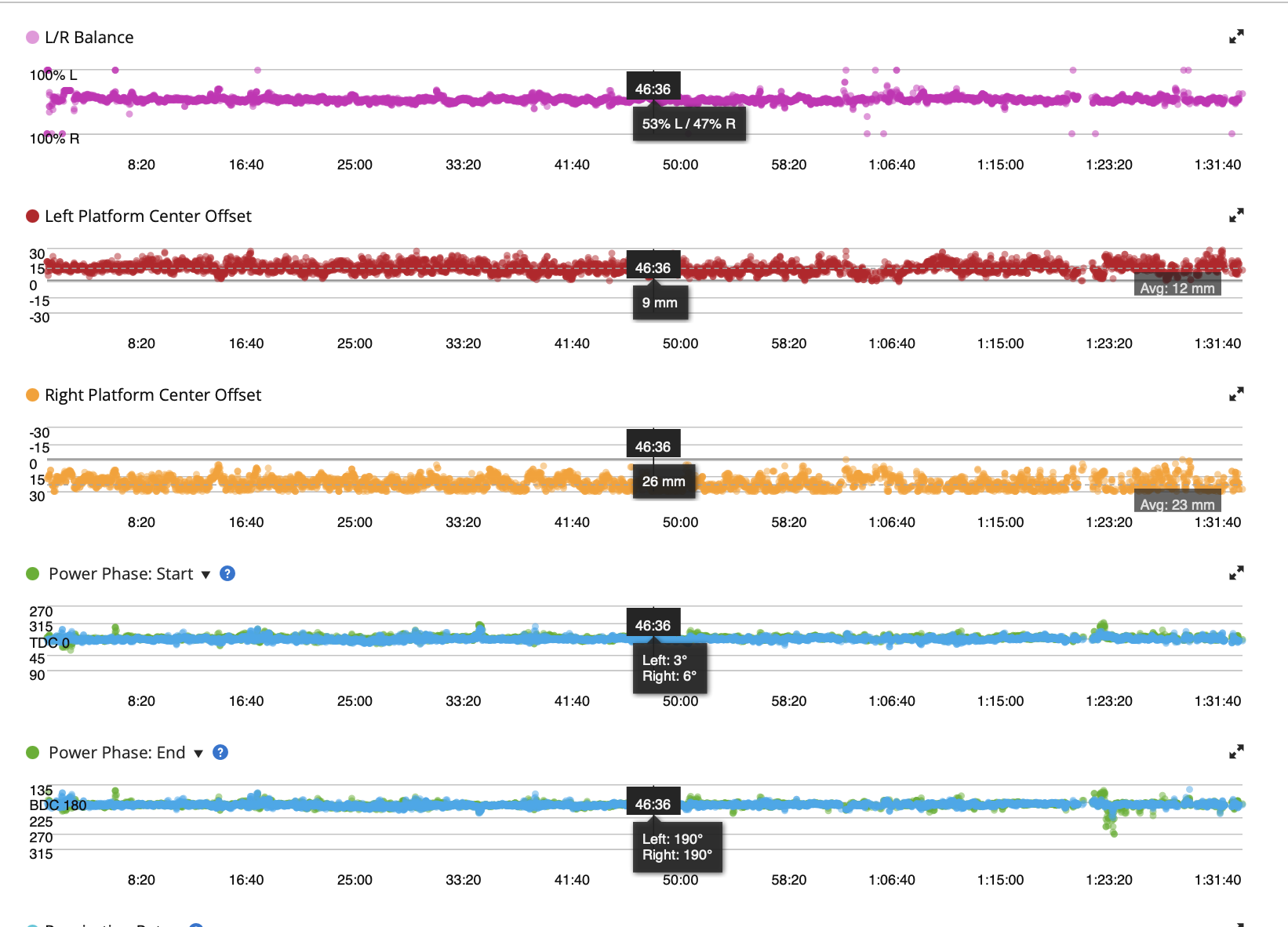
Instead of a single average, you can see the full trend: L/R balance stays close to 53/47% for most of the ride, and PCO (averaging +12 mm left, +23 mm right) is surprisingly stable despite changes in pace and saddle position. A consistent PCO gap between legs is worth tracking over several rides — it can point to differences in bike fit or a pedaling habit.
What does this mean for your training?
A single reading doesn't tell you much — the trend across many rides shows whether an asymmetry is worsening (say, after an injury) or is just a stable trait of your technique. Large L/R balance swings within one ride (standing on the pedals, fatigue) are normal — what matters is the average behavior within a given intensity range.
Bottom line
Cycling Dynamics from power pedals like the Favero Assioma add a layer of data beyond power and heart rate — they show technique, not just effort. Right now you read them in your head unit's companion app (here, Garmin Connect), but they're most useful alongside the rest of your training data.
Cycling Dynamics is coming to WattLog.pro
We're working on importing Cycling Dynamics data (L/R balance, Power Phase, PCO) into WattLog.pro, so you can analyze it alongside power, heart rate and TSS from the same ride.
Try WattLog.pro for free →