How many km on a trainer in a year? My 2,294 km and 87 h
Strava shows me 4,320 km and 137 activities for this year (as of 10 November), all in one pile. I wanted to know how much of that I rode at home, on the trainer. So I counted: from late April to 10 November it was 77 rides, 87 hours and about 2,294 km. That is almost half the time I spent on the bike this year. Since September I have ridden almost only indoors, and October was my strongest month of the whole year. Below are all the numbers, month by month, and what I learned from them. If you are wondering whether a trainer is worth it, this one is for you.
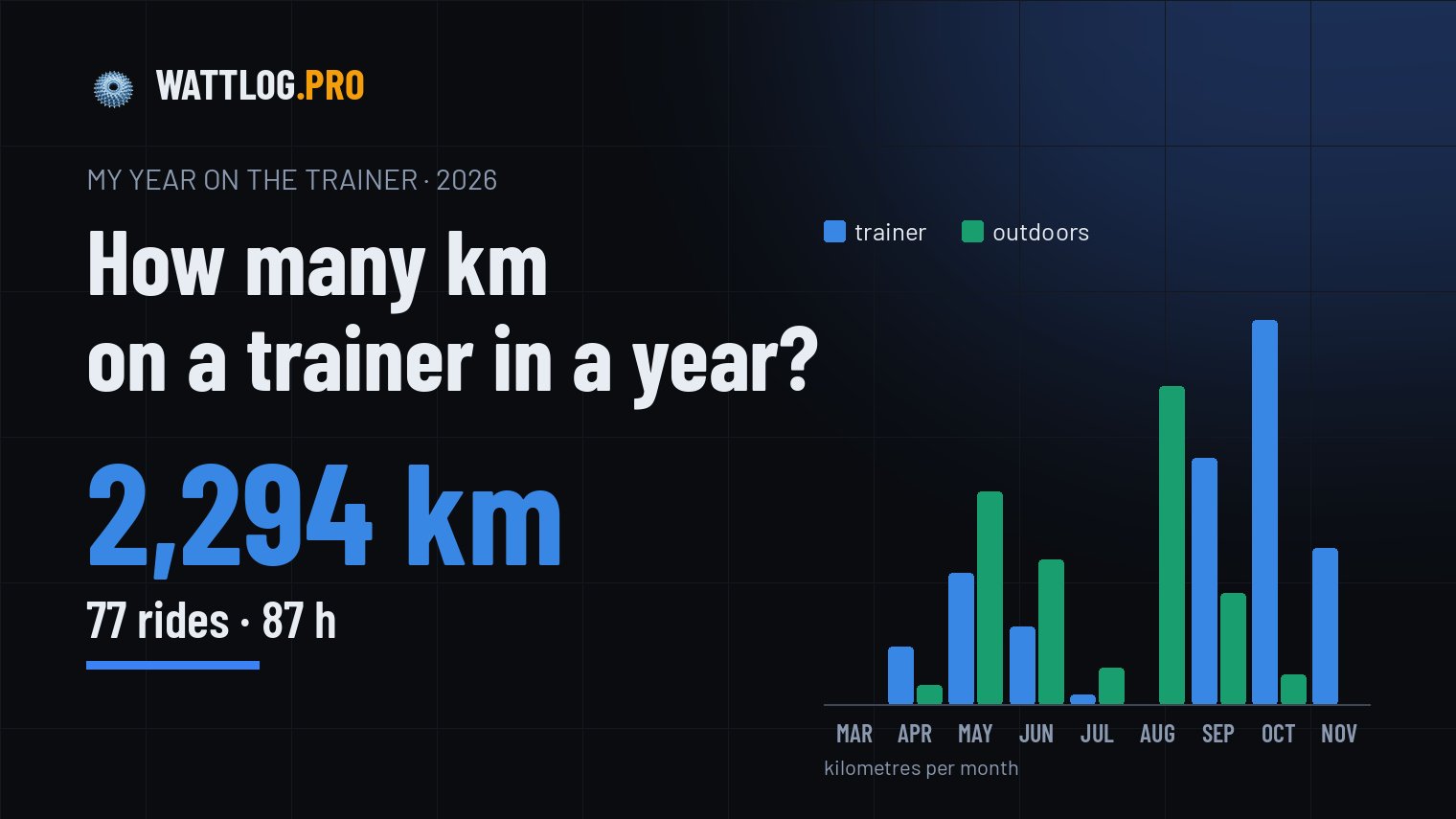
The year in numbers: trainer vs outdoors
On Strava, all my rides, the trainer ones included, end up in a single summary. That is why in November I added a Volume card to the app (Progress → Form). It splits rides into two groups: the ones ridden on the trainer with WattLog.pro, and the imported ones, which for me means outdoor rides from Strava and files from my bike computer. For my season it looks like this:
| Trainer (WattLog.pro) | Outdoors | |
|---|---|---|
| Rides | 77 | 69 |
| Time | 87 h | 105 h |
| Distance | 2,034 km stored + approx. 260 km estimated | 1,880 km |
| Average ride length | 68 min | 92 min |
| Elevation gain | 1,180 m (routes) | 10,080 m |
The hours are almost the same, but they are not the same hours. The 105 outdoor hours include descents, traffic lights, stops and long trips, like the 144 km ride to St. Anne's Mountain (Góra św. Anny) where I turned around 1.3 km short of the top (I wrote it up in the piece about my first attempt at St. Anne's Mountain). On the trainer every minute is pedalling at the power the plan sets. Why an hour at home tires you differently than an hour on the road is covered in an hour on the trainer vs an hour outside.
Month by month: autumn belongs to the trainer
The chart splits the year into three parts:
- Spring (April–June): a bit of everything. My first trainer rides with WattLog.pro, my first Ramp Tests, and more and more outdoor rides as the weather warmed up.
- Summer (July–August): outdoors or not at all. In July I barely rode: two weeks with no bike at all, then a few short spins. In August I made up for it with long rides around home: 686 km, not a single kilometre on the trainer.
- Autumn (September–November): almost only the trainer. In September I put a plan together and started riding to it. In October I rode 894 km, the most of the whole year, and 829 km of that (93%) was at home. It was getting dark earlier and earlier outside; at home that made no difference.
The most important thing for me is that the strongest month of the year was October, not August. Autumn, which usually means the end of the season, gave me my best training block of the year.
Week by week: consistency
Outdoors, my weeks jumped from zero to almost 13 hours, depending on the weather, holidays and how I felt. Since 7 September, on the other hand, I have 9 weeks in a row with 4–7 trainer rides each, which is 4.4–8.5 hours a week. That is not a lot. But it is every week, and that repetition is exactly what builds fitness. A week with 6 hours of riding is worth more than one 12-hour week after a two-week break. How many hours you need to make progress is covered in how many hours a week to train.
Most of my hours fall on Saturday (20 of 87), because that is when I do the longest ride of the week, usually 1.5–2 hours at an easy pace. Intervals are on Tuesdays and Thursdays. The other days are off or easy.
How does a trainer know how far I rode?
A bike on a trainer does not move, so trainer kilometres are always calculated. In WattLog.pro nobody guesses them: the number comes from two things the trainer or power meter really measures, power and time.
- ERG workouts and rides without a route: every second the app works out how fast you would go at that power on a flat road with no wind, at your weight plus 9 kg of bike. The sum over the whole ride is the distance.
- Route rides (GPX): the distance comes from the route and its gradient. You go slower uphill and faster downhill, just like outside. See how to ride a GPX route on a smart trainer.
An example from 7 November: a two-hour workout with a normalized power (NP) of 145 W gave 58.5 km. The same distance goes into the FIT file WattLog.pro sends to Strava, and the same number shows in the Volume card. That way the kilometres in the app and on Strava match.
Why does the card show 2,034 km and not 2,294 km? 13 rides from 24 April–12 May have no stored distance. Those were the app's first weeks. Heart rate and average power survived from those rides, but not second-by-second power. Average power and time give about 260 km, but that is an estimate, not a measurement. So the card does not guess for those rides: it counts them, shows how many there are, and leaves them out of the kilometres. In this article I add that estimate separately.
One thing has to be said honestly: a trainer kilometre is not the same as a kilometre on the road. There is no wind, no corners and no braking, and the model assumes flat tarmac. That is why I compare my rides mainly by hours and by work (kJ, TSS), and treat kilometres as a measure that is good for motivation. What load depends on is explained in what TSS is.
What those hours gave me
September and October gave the most, once I started riding to a 3+1 plan: three weeks of building, one lighter week, then a test. After one such cycle my FTP went up from 178 to 193 W. I wrote up the whole story, with the honest caveat that the tests were measured by different devices, in the 3+1 plan in practice. How to read load and freshness in the app is shown in the piece about the Form tab.
I weigh 93 kg and I am losing weight slowly, so it is not just FTP that matters to me but also watts per kilogram. The trainer helps a lot here: I can ride long in a low zone, without descents where I do no work and without climbs where, at my weight, it is easy to go over threshold. If you also have a few kilos to lose, read about losing weight by cycling.
How to start: a plan for your first month
You do not have to ride two hours straight away. My typical ride lasted 68 minutes. Three one-hour rides a week is about 13 hours a month, which at about 27 km/h is about 350 km. Over a year that adds up to more than my whole indoor season. This is what my first month would look like if I were starting over:
| Week | What you do | How long |
|---|---|---|
| 1 | Ramp Test to find your FTP and zones, plus 2 easy rides in zone 2 | approx. 2 h |
| 2 | 3 rides: Tuesday 45 min with 3 × 5 min at tempo, Thursday 45 min easy, Saturday 60 min easy | 2.5 h |
| 3 | 3 rides: Tuesday 60 min with 3 × 8 min at tempo, Thursday 60 min easy, Saturday 75–90 min easy | 3–3.5 h |
| 4 | Lighter: 2–3 short, easy rides. After it you can start your first real block and test every 4 weeks. | 1.5–2 h |
A few things that worked for me:
- Fixed days, not "when I find the time". Tuesday and Thursday are intervals for me, Saturday is the long ride. I do not ask myself whether to ride, only what is in the plan.
- A plan instead of aimless spinning. In August I rode a lot, but with no structure, and my FTP barely moved. Why that happens is explained in the piece about aimless spinning.
- ERG mode. The trainer holds the target power by itself, so I do not have to watch the watts, only my cadence. That makes an hour go by faster than you would think.
- A fan and water. At home there is no airflow and you sweat much more than outside. A strong fan is the best money you will spend.
- Something against boredom. A film, a podcast or a GPX route from your own area. You will find ideas in the piece on how to make trainer training less boring.
- Count hours, not kilometres. Kilometres look nice in a year summary, but fitness is built by hours and their quality.
If you are still putting your setup together, start with how to start training on a trainer and whether a trainer is worth buying. The list of trainers that work with WattLog.pro is on the compatible trainers page.
Frequently asked questions
How many kilometres is an hour on a trainer?
It depends on power and weight. At 102 kg (me plus the bike), 114 W gives about 27 km/h and 193 W about 34 km/h on the flat. On average I got 26.6 km per hour and 32 km per ride.
Are trainer kilometres real?
Power and time are measured, and the distance is calculated from them as if you were riding on a flat road with no wind. It is an honest measure of the work done, but not the same as a kilometre on the road, where there are descents, wind and stops.
Is the trainer alone enough to stay fit over winter?
For me it was enough to build fitness: the best month of the year and the biggest FTP gain came in autumn, when I rode almost only at home. What matters more than where you ride is whether you ride regularly and to a plan.
Do trainer rides go to Strava?
Yes. After a workout WattLog.pro sends Strava a FIT file with power, heart rate, cadence and the calculated distance, so the kilometres on Strava and in the app are the same. You switch on automatic upload in the settings.
This describes my rides and my results, not individual training advice. If you are just starting out or have health problems, talk to a doctor before harder training.
Data and method
Where the numbers come from. All rides are stored in my WattLog.pro account. I counted completed rides from 1 January to 10 November 2026. Trainer means rides recorded in the app (ERG workouts, routes, Ramp Tests, riding at a fixed gradient): the first on 24 April. Outdoors means 46 rides imported from Strava (1,805 km, 88 h, all with GPS) and 23 TCX files from my bike computer from March–May (17 h, only 2 with a stored distance). No Strava ride overlaps a trainer ride. I checked the Strava summary (4,320 km, 137 activities) on 10 November.
How I counted.
- Time is the time from the start to the end of the ride minus pauses, as in the Volume card.
- Trainer distance is the sum of speeds from the flat-road model (rolling resistance 0.004, CdA 0.32 m², air density 1.2 kg/m³, profile weight + 9 kg of bike), calculated from every power sample [1]. On GPX routes the distance follows from the route gradient.
- The 260 km estimate for the 13 rides without distance: the model speed for the ride's average power times the ride time, at 102 kg. Average power underestimates compared with second-by-second calculation, so it is more of a lower bound.
- FTP is 75% of the best 60-second power from the Ramp Test. TSS is calculated from NP and the FTP set on the day of the ride [2].
Limitations. This is one person's data. Until mid-September power was measured by the trainer, then by Assioma pedals, and their readings can differ by a few percent (more in the piece about power match). Power on outdoor rides before September was estimated by Strava without a power meter, so I do not compare TSS or kJ between the trainer and outdoor riding.
Sources
- Martin JC, Milliken DL, Cobb JE, McFadden KL, Coggan AR. Validation of a mathematical model for road cycling power. J Appl Biomech. 1998;14(3):276–291. doi:10.1123/jab.14.3.276
- Allen H, Coggan AR, McGregor S. Training and Racing with a Power Meter. 3rd ed. Boulder: VeloPress; 2019.
Train smarter with WattLog.pro
WattLog.pro collects data from your trainer and shows what's really happening with your fitness.
Try WattLog.pro for free →